

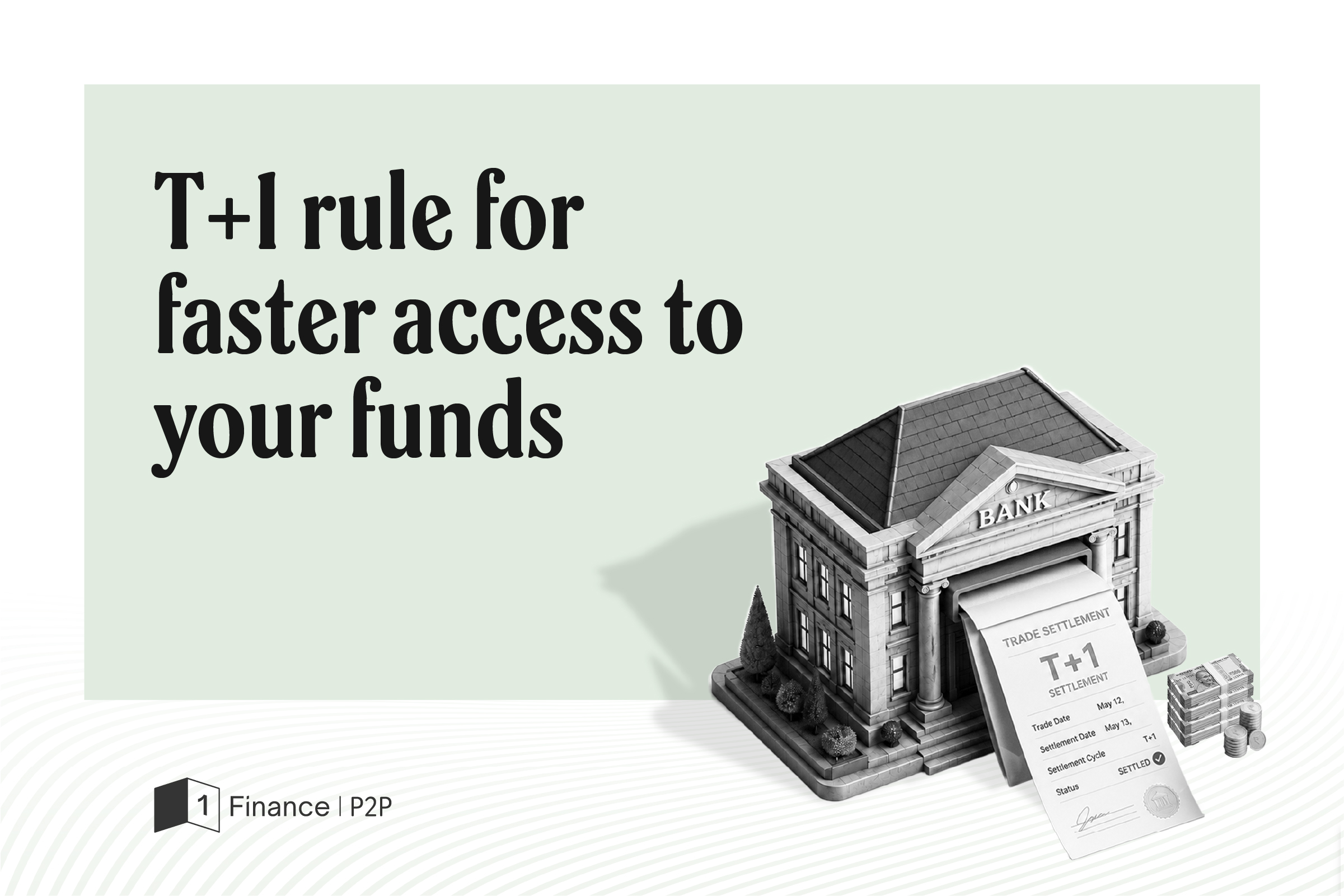
Before the T+1 settlement rule in P2P lending, the timing of your money was the P2P platform's call to make. Funds you committed could sit unallocated while the P2P lending platform assembled loan opportunities, and repayments moved through collection and distribution cycles before reaching you. The system functioned, but the timeline your money followed was seldom visible to you.
The moment your funds entered the system was usually clear enough. Everything after that point was harder to trace. A transaction would show on your dashboard, yet tell you little about where the money actually rested or how long it would stay there.
The T+1 settlement framework replaces that discretion with a firm obligation. Rather than letting each P2P lending platform set its own pace, the Reserve Bank of India now prescribes it.
The T+1 settlement rule holds P2P lending to the same standard as India's capital markets
The T+1 settlement rule isn't new to Indian finance. Stocks on Indian exchanges have settled at T+1 (Trade + 1 day) since January 27th, 2023. Mutual fund subscriptions and redemptions clear within similar windows. Indian capital markets accepted the principle years ago, that money shouldn't sit in custody longer than one business day after a transaction begins.
The Reserve Bank of India brought that same principle to P2P lending in August 2024, with the settlement clause taking effect from November 15th, 2024. For P2P lenders, the effect is direct. Money you lend now clears under the same settlement discipline that governs the equity and mutual fund holdings in your portfolio.
Three ways the T+1 settlement rule works in your favour as a lender
Every rupee you lend stays traceable. On any given day, your money sits in one of two identifiable places, with a specific borrower against a P2P loan you can name, or in an escrow account with the T+1 clock already running. The platform can no longer hold an undetermined sum of your money in an undefined place, once the most common risk in this industry.
Cash drag on your portfolio falls sharply. Money reaches your bank account within one business day of a prepayment, a completed loan, or an exit from a position. The stretch of time your capital spends earning nothing now carries a hard ceiling set by the rule, with no room left for platform discretion.
Picture a borrower prepaying ₹50,000 midway through a loan. Under the T+1 settlement rule, that ₹50,000 lands in your bank account by the next business day, free to redeploy into a new loan or use as you see fit. Under the older P2P lending model, the same amount could pass through collection and distribution cycles for an unpredictable stretch, earning nothing while it waited. That’s because no rule capped how long it could sit. Repeat that across every prepayment and maturity in a year, and the days of idle capital the rule removes begin to add up.
Platform economics change in a way that protects you. Float income disappears, so operators earn their revenue from disclosed fees tied to the principal you lend, rather than from money they happen to be holding. A clean fee structure takes the place of an opaque one.
The T+1 settlement rule doesn’t remove your credit risk
The T+1 settlement rule governs where your money sits. Whether a borrower repays it is a separate question the rule leaves untouched. When you lend on a P2P platform, the credit risk is yours to carry, and the RBI NBFC - P2P 2024 guidelines has bluntly stated it in plain terms. A platform cannot assume that risk, guarantee your principal, or promise a minimum return, which is why every lender now signs an explicit declaration acknowledging as much before lending.
Faster settlement carries your repayments to you within a business day, yet the size of those repayments still depends on how well the underlying loans perform. A borrower's default is a different risk from money idling in transit, and the settlement rule leaves default exactly where it was, with you.
Reading a P2P platform's disclosed default and recovery figures therefore matters as much as trusting its settlement timeline. One protects your money on the way to you, and the other tells you what your money is doing while it is lent out.
The rules that work alongside T+1 settlement to protect you
The T+1 settlement rule arrived as part of a wider 2024 overhaul, and a handful of companion rules reinforce it. Each one closes a different route through which your money once slipped out of view.
The escrow structure ring-fences your funds. Money moves only through escrow accounts run by a bank-promoted trustee, and the balance in a lender's escrow cannot be used to repay another lender or to disburse an unrelated P2P loan. That capital stays yours until it reaches the specific borrower you lent to.
Fee rules tie a platform's revenue to transparency. A platform must disclose its fee at the time you lend, set either as a fixed amount or as a fixed proportion of the principal, and that fee cannot rise or fall with whether the borrower repays. The charge you see going in is the charge you pay.
A cross-selling ban keeps the product clean. A platform cannot bundle unrelated products with your loan, nor dress up lending with insurance that works as a repayment guarantee. The product you lend into stays a loan, with its risks shown rather than masked.
The closed user group ban shuts out self-dealing. A platform cannot match you with borrowers drawn from a private circle sourced through an affiliate, an arrangement that once let related parties route money among themselves. The borrower on the other side of the loan is a genuine third party.
The checks that confirm a platform follows these rules
The rules bind every registered platform, and a few visible signs tell you whether one is honouring them in practice.
Start with registration. A genuine platform operates as an RBI-registered NBFC-P2P and says so, alongside the required caveat that registration doesn't make the RBI responsible for your repayment. A P2P lending platform that blurs this, or that markets lending as an assured-return product, is already stepping outside the rules.
Check the disclosures next. Every P2P platform must publish its portfolio performance on its website, including the share of non-performing loans and the losses lenders have borne on principal and interest. Numbers that are current, specific, and easy to find point to a platform comfortable with scrutiny. Their absence, or a vague summary in their place, is a warning worth heeding.
Look at how your money is held and priced. Funds should move through a bank-promoted trustee escrow account, and the fee should appear upfront as a fixed amount or a percentage of principal, with nothing contingent on borrower repayment. A settlement timeline you can see on your dashboard, with money reaching your account within a business day of a repayment, tells you the T+1 settlement rule is working as intended.
P2P lending's place as an alternate finance
Together, these rules answer a question that once hung over the industry, whether a P2P platform can be trusted to handle your money responsibly. That question is now answerable with evidence rather than trust alone.
The more useful question is where P2P lending belongs in your strategy. The answer turns on how much credit risk you are willing to carry. P2P lending now runs on the same settlement rhythm as the capital markets and mutual funds you already hold, which makes it easier to weigh as one considered option rather than an experiment.

Tejashree Satpute
Tejashree is a Senior Finance Content Writer at 1 Finance, specializing in-depth financial research and content strategy. With over 5 years of writing experience, she turns complex market data into accessible insights. Outside of finance, she enjoys classic literature, poetry, and long walks.